HRMS vs HR Software: What's the Difference (and Which One Does Your Business Actually Need?)
Share
If you're looking for software to simplify HR operations, you've probably come across two terms repeatedly HR Software and HRMS. Some vendors use them interchangeably, while others describe them as completely different solutions.
So what's the real difference, and which one is right for your business?
The short answer is this: every HRMS is HR software, but not every HR software is an HRMS.
The real difference lies in how much of your HR operations the software can manage. In this guide, we explain both in simple terms and help you decide which solution best fits your business.
What is HR Software?
In simple terms, HR software refers to any digital tool that helps businesses automate one or more Human Resource functions.
It could be software for payroll, attendance, recruitment, leave management, performance reviews, or employee engagement. Each application is built to solve a specific HR challenge.
For example, a company might use:
One application for payroll
Another for attendance
A separate system for recruitment
Excel sheets for employee records
Technically, they're using HR software—but each system works independently.
For some businesses, that's perfectly adequate, especially when the workforce is small and HR processes are relatively simple.
What is an HRMS?
An HRMS (Human Resource Management System) goes a step further.
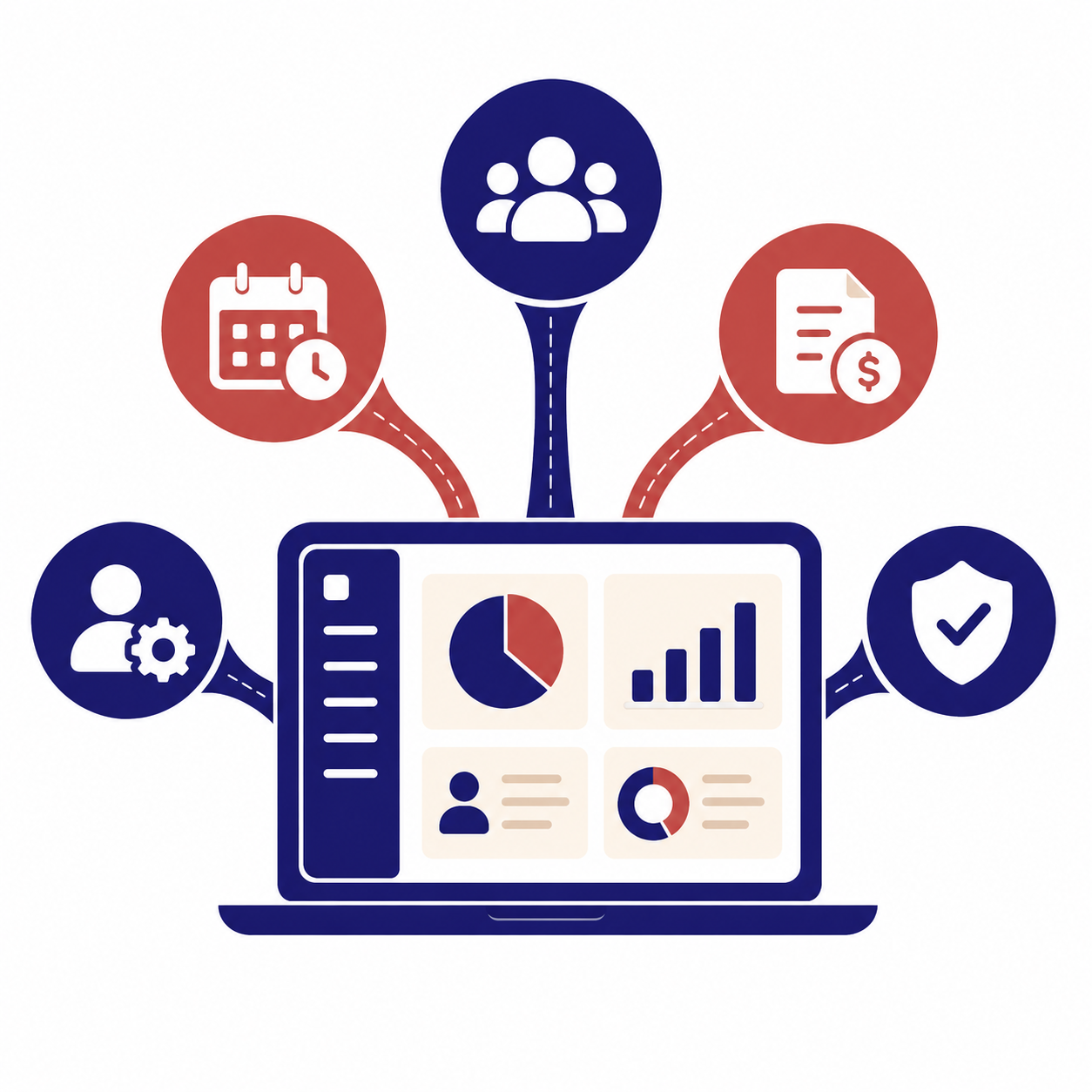
Instead of solving just one HR problem, it brings all major HR processes together in a single platform.
A modern HRMS typically includes:
Employee Information Management
Attendance & Time Tracking
Leave Management
Payroll Processing
Employee Self-Service (ESS)
Recruitment & Onboarding
Performance Management
Shift & Roster Management
Expense Management
Document Management
Statutory Compliance
HR Reports & Analytics
Since every module shares the same employee database, information only needs to be entered once. The entire HR process becomes connected, reducing manual work and minimizing errors.
The Biggest Difference: Integration
Here's the easiest way to understand it.
Imagine your HR team uses:
One application for attendance
Another for payroll
A different one for leave management
Spreadsheets for employee records
Yet another system for performance reviews
Now a new employee joins the company.
The HR team has to create that employee in every system. If the employee changes their phone number, bank account, or department later, the same update has to be made in multiple places.
Generating reports becomes another challenge because the data lives in different applications.
Now imagine using a single HRMS.
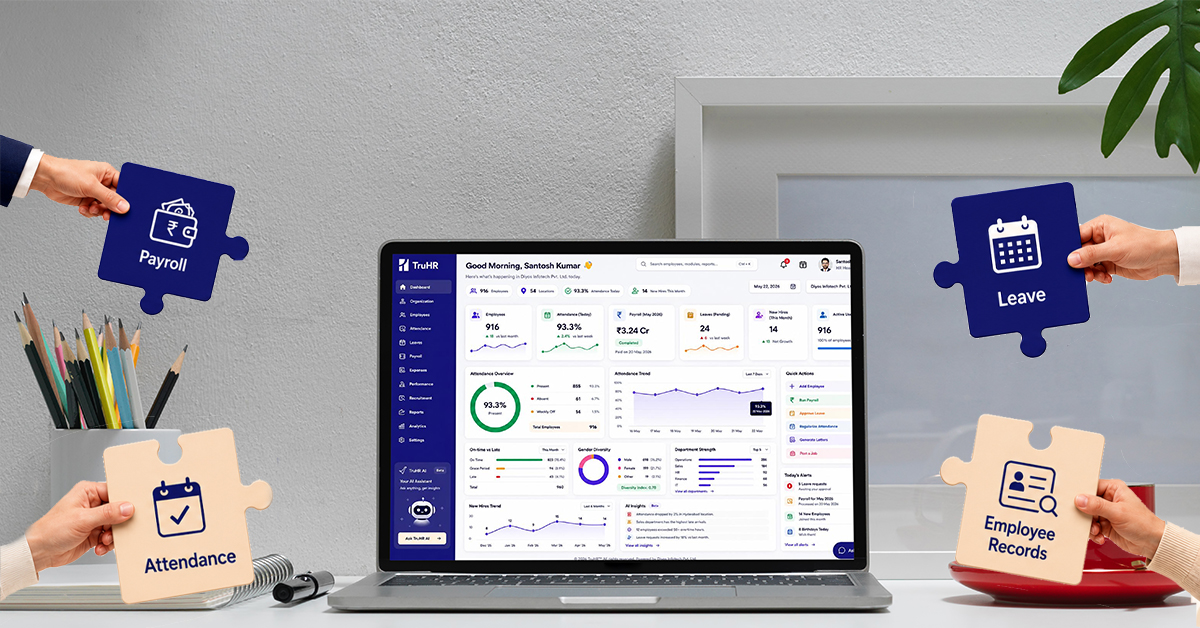
The employee profile is created once, and every module—attendance, leave, payroll, performance, and employee records—uses the same data automatically. Reports are generated instantly because all the data already lives in one place.
That's the real difference between HR software and an HRMS.
HRMS vs HR Software: A Quick Comparison
Feature
HR Software
HRMS
Purpose
Automates one or a few HR tasks
Manages the complete HR lifecycle
Data
Stored in multiple systems
Stored in one centralized database
Integration
Limited
Fully integrated
Reporting
Module-specific
Organization-wide insights
Automation
Task-level
End-to-end HR automation
Best For
Businesses with simple HR needs
Growing organizations looking to scale
Which One Should You Choose?
The answer depends on where your business is today.
HR Software may be enough if:
You're a small business with basic HR requirements.
You only want to automate payroll or attendance.
Your existing processes are manageable.
You don't mind using different tools for different functions.
An HRMS is a better choice if:
Your workforce is growing.
You manage employees across multiple branches, stores, offices, or project sites.
HR spends too much time on repetitive administrative work.
Employee information is spread across multiple systems.
You need accurate, real-time reports.
You want employees to access payslips, apply for leave, or update personal details without involving HR.
You want a solution that can grow with your business.
Many organizations start with standalone HR software. But as the company grows, managing multiple disconnected systems often becomes inefficient. That is usually the point where businesses switch to an integrated HRMS.
Common Mistakes When Selecting HR Software
Choosing HR software isn't just about solving today's challenges—it's about investing in a solution that supports your business as it grows. Unfortunately, many organizations make decisions that lead to costly upgrades or system changes later.
One of the biggest mistakes is choosing software based only on price. While affordability matters, the cheapest option may lack essential features, integrations, or scalability, resulting in higher costs over time.
Another common mistake is focusing on a single HR function. A business may purchase payroll software today, only to realize later that it also needs attendance, leave management, performance tracking, and employee self-service. Managing multiple disconnected systems often creates duplicate work and inconsistent data.
Companies also tend to overlook user experience. If the software is difficult for employees and managers to use, adoption suffers and HR teams end up handling tasks that should be self-service.
Finally, many businesses underestimate the importance of reporting, compliance, and customer support. A good HR solution should provide meaningful insights, stay updated with changing regulations, and offer reliable support when you need it most.
The best HR software is one that not only meets your current needs but also grows with your business.
Why More Businesses Are Choosing HRMS Platforms
According to industry studies, HR teams spend a significant portion of their time on repetitive administrative tasks such as attendance tracking, leave approvals, and payroll processing. Modern HRMS platforms help automate many of these activities, allowing HR professionals to focus on strategic initiatives such as employee engagement and talent development.
A modern HRMS helps organizations:
Save time by automating routine HR activities
Reduce manual errors caused by duplicate data entry
Improve compliance with statutory regulations
Give employees self-service access through web and mobile apps
Make faster decisions with real-time dashboards and analytics
Deliver a better employee experience from onboarding to exit
Instead of HR spending time on administrative work, they can focus on building a better workplace and supporting business growth.
How Different Industries Benefit from an HRMS
While every organization manages employees, each industry has unique workforce challenges. A modern HRMS adapts to these requirements by providing industry-specific capabilities.
Manufacturing companies use HRMS platforms to manage shifts, overtime, attendance, payroll, and statutory compliance for large workforces
Retail businesses benefit from centralized employee management across multiple stores, simplified shift scheduling, leave management, and mobile self-service for frontline employees.
In healthcare, an HRMS helps manage rotating shifts, maintain employee records, track certifications, and ensure accurate payroll for doctors, nurses, and support staff.
Logistics and supply chain organizations rely on HRMS solutions to manage distributed teams, track field attendance through mobile or GPS-based check-ins, and automate payroll for employees working across different locations.
Other industries such as education, hospitality, IT services, automobile dealerships, and facility management also benefit from HRMS platforms by streamlining HR operations and improving employee experience.
Regardless of the industry, organizations with multi-location operations, shift-based employees, or growing workforces benefit the most from an integrated HRMS, as it eliminates manual processes, improves accuracy, and provides a single source of truth for all employee information.
HRMS vs HRIS vs HCM: What’s the Difference?
System
Purpose
HRIS
Stores and manages employee information.
HRMS
Combines HRIS with payroll, attendance, leave, compliance, and workforce management.
HCM
Goes beyond HRMS by including strategic talent management, succession planning, and workforce development.
For most small and medium-sized businesses, an HRMS offers the ideal balance of functionality, ease of use and affordability.
Frequently Asked Questions
Is HRMS different from HR software?
Does every company need an HRMS?
Not necessarily. Smaller businesses with less than 20 employees and simple HR requirements may be well served by standalone HR software. However, businesses planning to grow often find an HRMS to be a better long-term investment.
Is payroll software an HRMS?
Can an HRMS replace multiple HR applications?
Final Thoughts
Ultimately, the choice isn't between HR software and HRMS—it's between managing HR through disconnected tools or through one integrated platform.
If your business is growing, your HR technology should grow with it. Investing in the right HRMS today can save countless hours of manual work, improve employee experience, and give your leadership team the insights needed to make better decisions tomorrow.
Looking for a Modern HRMS?
TruHR is a cloud-based HRMS designed for growing businesses. From attendance, leave, and payroll to employee records, compliance, and performance management, TruHR helps organizations manage their entire HR operations through one unified platform.
Book a personalized demo today and discover how TruHR can simplify your HR processes while preparing your business for future growth.
TruHR transforms traditional HR management by automating essential tasks such as onboarding, attendance, leave management, payroll, compliance and field employee management.