Is Your Salary Structure Ready for the Code on Wages?
Share
Key Takeaways
The Code on Wages does not require Basic Pay alone to be 50% of gross salary or CTC. It defines wages broadly and expressly includes Basic Pay, Dearness Allowance, and Retaining Allowance while excluding specified components.
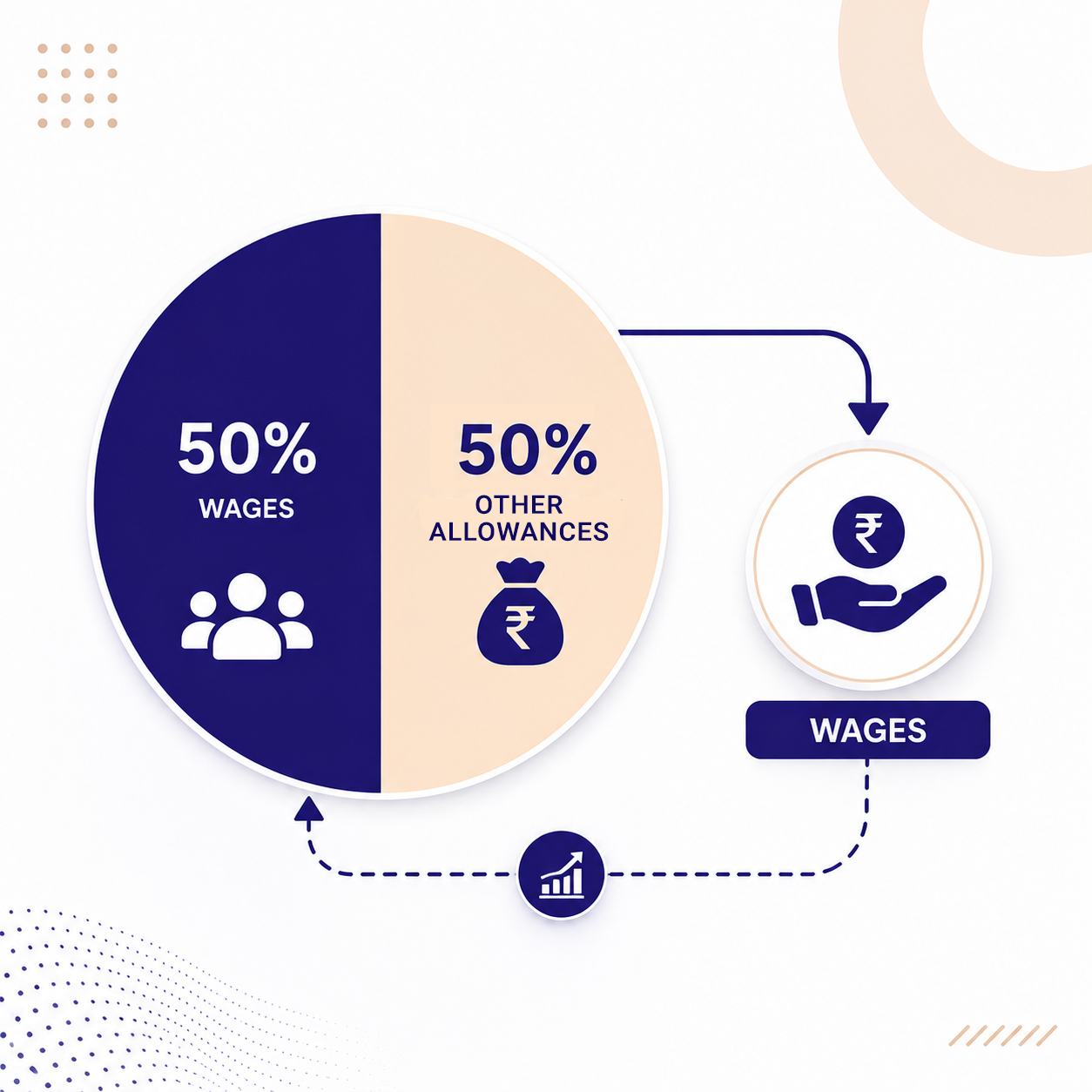
The aggregate of exclusions listed in Section 2(y)(a) to (i) cannot remain above 50% of total remuneration under the wage definition. Any excess is added back to wages.
The relevant compliance test is the statutory wages amount, not the percentage of Basic Pay alone. A restructuring may affect statutory contribution bases and take-home pay depending on the applicable law and the employee’s salary components.
Introduction
Start with your payslip and classify each component under the statutory definition of wages. The key question is not whether Basic Pay is below 50% of gross salary. It is whether the salary structure correctly includes and excludes components and applies the 50% add-back rule under the Code on Wages.
Section 2(y) of the Code on Wages defines wages as all remuneration payable under the terms of employment, whether by salary, allowance, or otherwise. It expressly includes Basic Pay, Dearness Allowance, and Retaining Allowance, if any, and then lists specific exclusions. If the aggregate payments under exclusions (a) to (i) exceed 50% of total remuneration, the excess is deemed remuneration and added back to wages.
All four Labour Codes, including the Code on Wages, came into force on 21 November 2025, and the Code on Wages (Central) Rules, 2026 were notified on 8 May 2026. States continue to roll out their own rules at different times. The pending state-level rollout does not change the central definition of wages, but employers should check the rules applicable to each establishment.
What Is the 50% Wage Rule Under the Code on Wages?
The Code does not prescribe that Basic Pay must equal 50% of gross salary or CTC. Instead, it limits how much of total remuneration may remain outside wages through the specified exclusions in Section 2(y)(a) to (i).
When those exclusions exceed 50% of total remuneration, the excess amount is added back into wages. This is why the provision is commonly called the 50% wage rule. Basic Pay is one included component, but it is not the statutory measure by itself. Other remuneration not specifically excluded may also form part of wages.
Does Basic Pay Alone Need to Be 50% of Gross Salary?
No. Basic Pay alone is not required to be 50% of gross salary. Employers must calculate wages using the statutory definition, apply the listed exclusions, and add back any excess above the 50% limit. Because gross salary and CTC are commercial payroll terms rather than the statutory test, the comparison should be made against total remuneration under Section 2(y).
Which Salary Components Are Included in or Excluded from Wages?
The treatment of a component depends on its substance and the terms of employment, not merely the label used on the payslip. The component-wise position under Section 2(y) is summarised below.
Salary / Remuneration Components Under Section 2(y)
Classification
Component
Treatment under Section 2(y)
Included
Basic Pay
Expressly included in wages.
Included
Dearness Allowance (DA)
Expressly included in wages.
Included
Retaining Allowance, if any
Expressly included in wages.
Included
Other salary, allowance or remuneration payable under the terms of employment
Included unless it falls within a specific statutory exclusion. A generic “Special Allowance” is not automatically excluded.
Included - conditional
Bonus or incentive forming part of remuneration under the terms of employment
Included where it does not fall within the statutory-bonus exclusion or the commission exclusion; substance and contract terms matter.
Included - deemed
Remuneration in kind
When provided in lieu of all or part of wages, value up to 15% of total wages is deemed part of wages.
Excluded - 50% cap
Statutory bonus not forming part of remuneration under the terms of employment
Clause (a).
Excluded - 50% cap
Value of house accommodation; supply of light, water, medical attendance or other amenity; or any service excluded by Government order
Clause (b).
Excluded - 50% cap
Employer contribution to pension or provident fund, including accrued interest
Clause (c).
Excluded - 50% cap
Conveyance allowance or travelling concession
Clause (d). Included for equal-wage and payment-of-wages computation under the second proviso.
Excluded - 50% cap
Payment to defray special expenses arising from the nature of employment
Clause (e). Treatment depends on the payment’s purpose, not merely its label.
Excluded - 50% cap
House Rent Allowance (HRA)
Clause (f). Included for equal-wage and payment-of-wages computation under the second proviso.
Excluded - 50% cap
Remuneration under an award, settlement or court/tribunal order
Clause (g). Included for equal-wage and payment-of-wages computation under the second proviso.
Excluded - 50% cap
Overtime allowance
Clause (h). Included for equal-wage and payment-of-wages computation under the second proviso.
Excluded - 50% cap
Commission
Clause (i).
Excluded - outside cap
Gratuity payable on termination of employment
Clause (j). Outside the clauses (a) to (i) add-back calculation.
Excluded - outside cap
Retrenchment compensation, other retirement benefit, or ex gratia payment on termination
Clause (k). Outside the clauses (a) to (i) add-back calculation.
Important: The 50% test applies to the aggregate of exclusions in clauses (a) to (i), not to each component separately. Only the amount above 50% is added back to wages. Component labels alone are not conclusive; the payment’s substance and the terms of employment must be reviewed.
How Does Understanding Your Salary Structure Help You Plan Ahead?
Understanding the wage composition helps employees compare take-home pay and statutory benefits, and helps employers budget and configure payroll accurately. Two employees with the same CTC may have different wages under the Code because their remuneration components differ. Salary negotiations should therefore look beyond CTC and review the included and excluded components.
When Do the India Labour Codes Actually Take Effect?
The Central Rules were notified in May 2026, while state-specific rules, forms, and timelines continue to roll out unevenly. Employers should apply the central wage definition and also monitor the rules applicable in each State. Payroll software should therefore support State-wise configuration rather than rely on a single static spreadsheet.
Conclusion
The rule changes how remuneration is classified between wages and permitted exclusions. The correct question is not whether Basic Pay is 50% of gross salary, but whether wages have been calculated under Section 2(y) and the excess exclusions, if any, have been added back. The payroll engine on our HR technology platform TruHR automatically tracks State-wise changes and updates wage-component, PF and gratuity calculations for you.
As salary structures evolve under the Code on Wages and state rules continue to roll out, keeping payroll calculations accurate can become challenging. A payroll system that automatically adapts to regulatory changes can help businesses stay compliant while reducing manual effort.
See how TruHR simplifies payroll compliance..
FAQs
Does Basic Pay alone have to be 50% of gross salary?
How should the 50% wage rule be applied to employees already on the rolls?
The statutory wage definition should be applied consistently to existing and new employees. Employers should review each salary component, apply the exclusions and add-back rule, and amend salary structures only where required. There is no need to force Basic Pay alone to 50% merely to satisfy the Code.
Does the definition of wages include Dearness Allowance?
What would happen to my take-home salary?
TruHR transforms traditional HR management by automating essential tasks such as onboarding, attendance, leave management, payroll, compliance and field employee management.